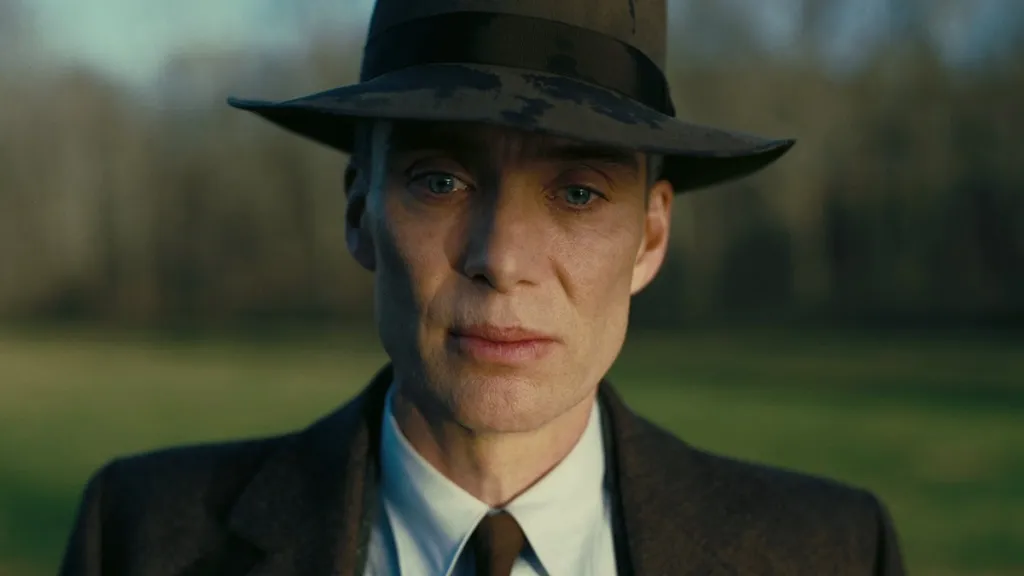
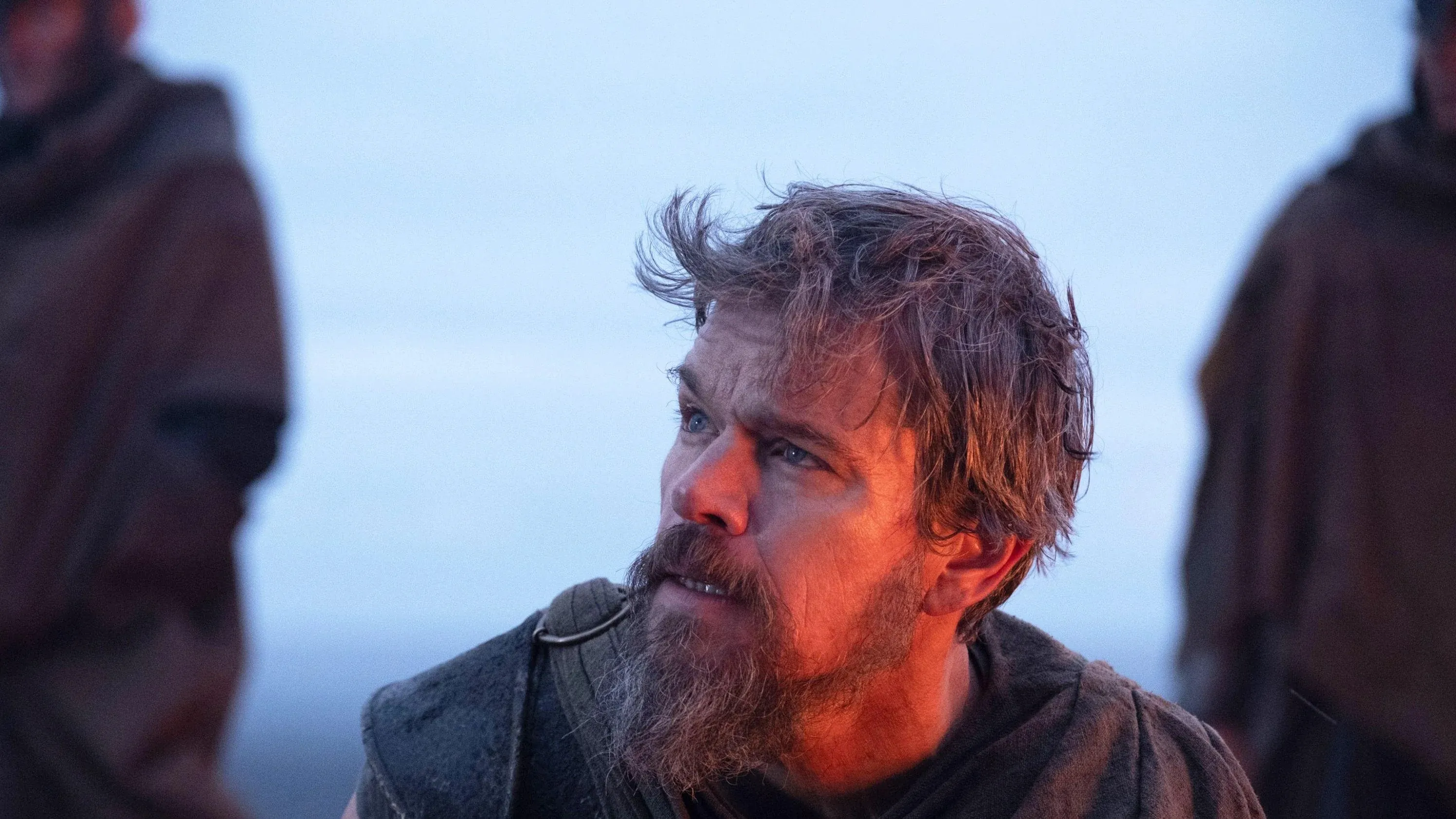
1. In the mythology of Christopher Nolan’s The Odyssey (2026), the gods do not exist—or at least, they never show themselves. There is no Poseidon, only the storm. No Zeus, only thunder, and a law laid down in his name. No Athena, only a statue and a priestess, both beheaded, merging into an illusory figure that will go on haunting the hero. What, then, is Nolan after? Is he trying to excavate a more “realistic” Bronze Age beneath the myth, disenchanting religion back toward its origins in natural forces, just as he reduces the motive of the Trojan War from the jealousy and elopement of female figures to the power struggles of male ones? Yet, in contrast to the gods’ withdrawal, those equally unreal monsters of legend all remain: the Cyclops, the Laestrygonians, the six-headed Scylla, the Sirens, Circe’s sorcery, the shades of the underworld. The supernatural isn’t completely abolished, but stripped of everything affirmative or life-giving: it appears only as something inhuman, alien, and purely terrifying—as danger. Nolan has already staged a first rehearsal for his long-discussed horror-film ambitions: a monster movie, the latest spin-off from Universal Monsters or Warner Bros.’ MonsterVerse.
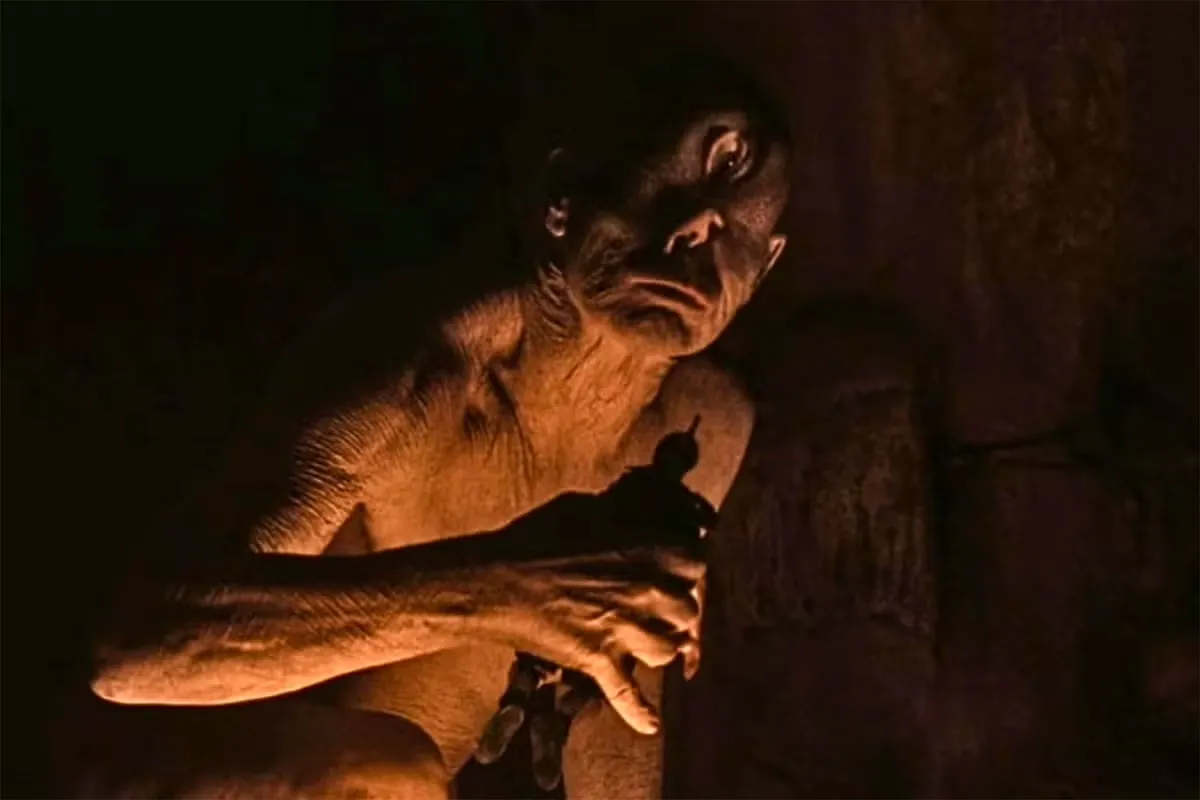
2. Nor do the Olympians disappear alone. With them vanish all the Homeric “paradises” that once punctuated Odysseus’s journey, those loci amoeni (pleasant places) blessed with divine bounty: springs that never cease, food that never runs out, spices and fabrics, vessels of gold and silver, all promising a happiness beyond home that nearly makes the returneesforget their return. Even the islands inhabited by the Cyclopes, Laestrygonians, Circe and the cattle of Helios are lands of material plenty, merely in the possession of others. In Nolan, by contrast, every destination is barren, savage, and barely inhabited: gray tidal flats, empty wastelands, sheer cliffs, desiccated forests. The Calypso episode no longer takes place in a Baroque grotto like the one depicted by Brueghel, but on an inhospitable island where two shipwreck survivors live hand to mouth by fishing, while the utopian homes of Aeolus and the Phaeacians disappear altogether. Between Homer’s bountiful paradises and Nolan’s hostile wilderness lies a historical shift in how we imagine the transcendent: from the ancient dream of nature’s inexhaustible feast to a post-Kantian awe before nature’s overwhelming power. The latter does not manifest itself through rich sensuousness, but through abstraction—solid color, crushing scale, deafening noise, a sublime yet indifferent monumentality that has become Hollywood’s standard visual grammars of “epic” grandeur sincePrometheus (2012), Dune (2021) and other 2010s prestige spectacles, and is amplified here to its logical extreme by Nolan’s obsession with IMAX.
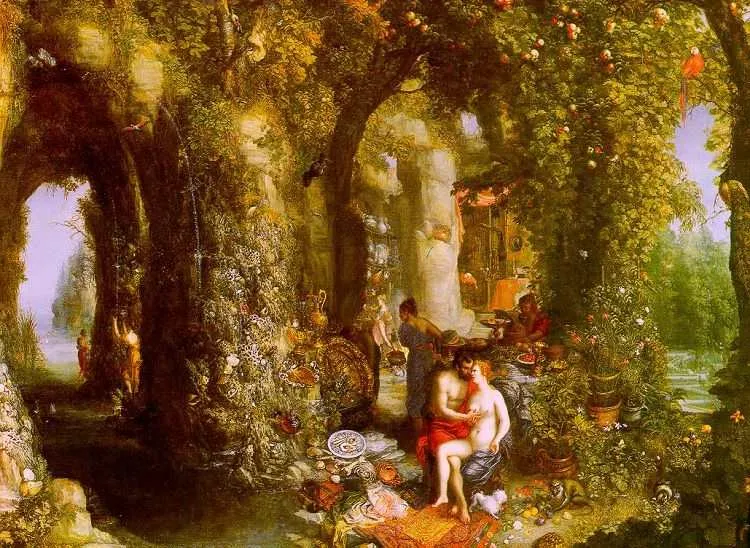
by Jan Brueghel the Elder
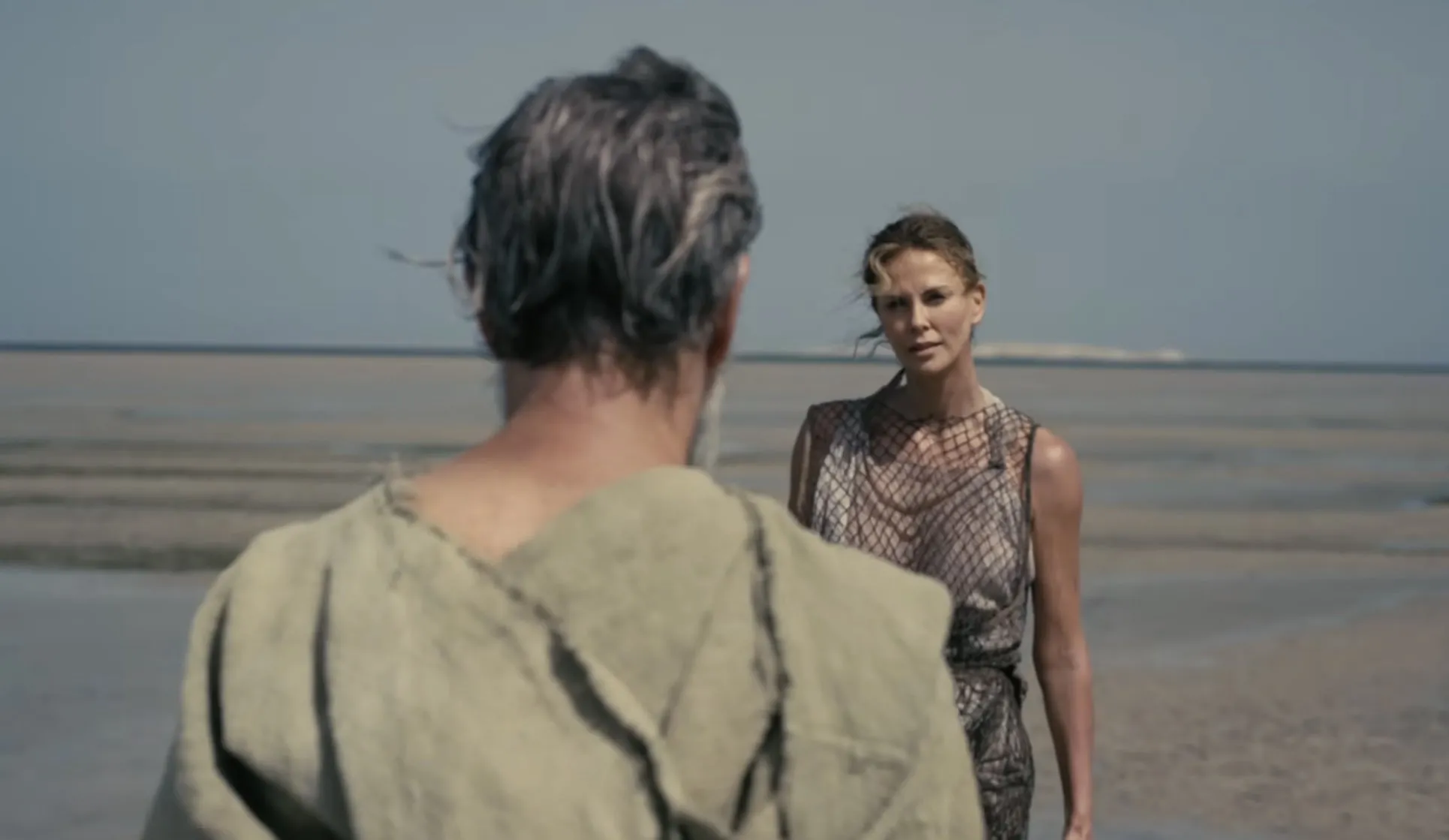
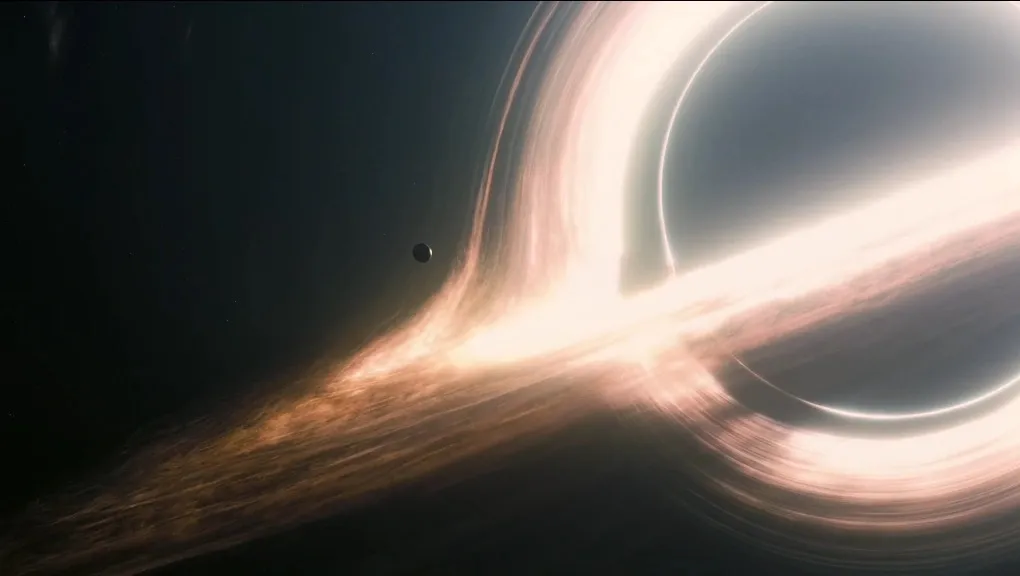
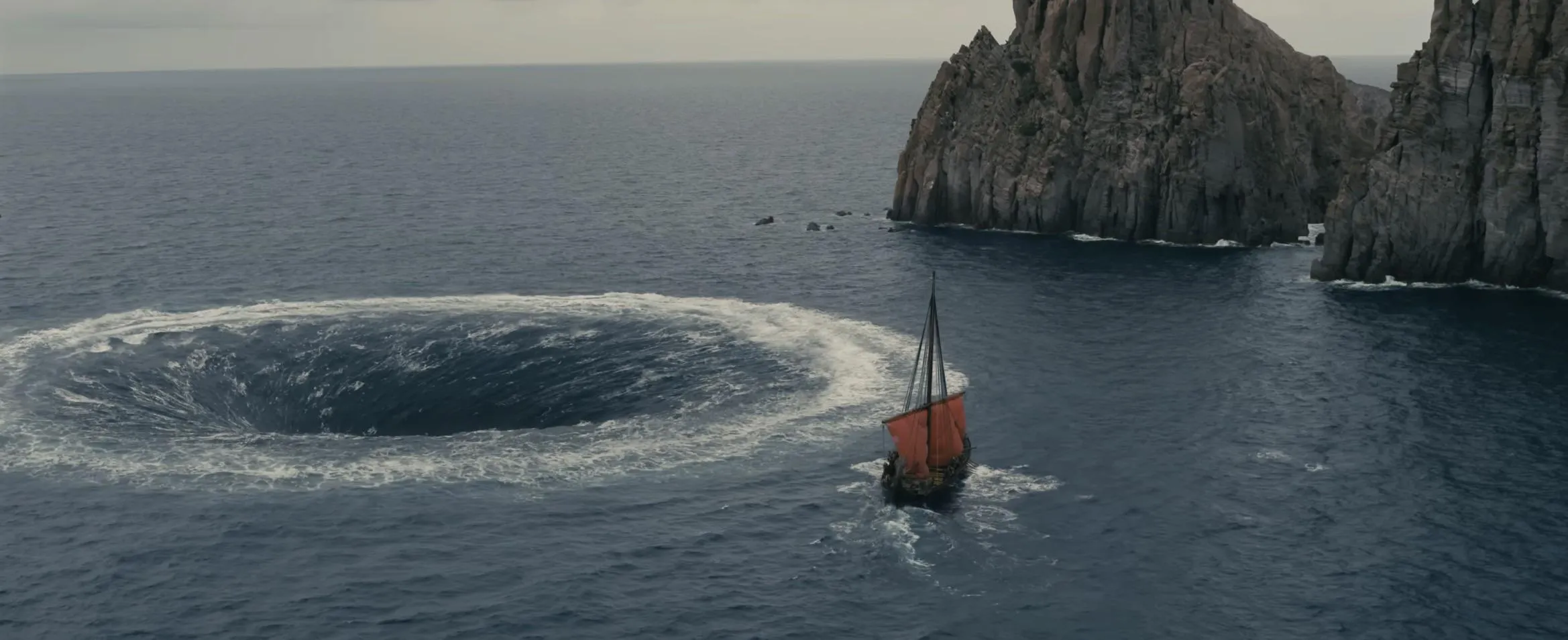
3. Thus there are no longer landscapes tempting one to linger, no adventures or marvels for their own sake, only the one direction left: home—and a succession of dangerous territories blocking the way, which reject every visitor and are scarcely possible even to pause in, let alone stay—unless as a captive. What begins as a grand voyage to “see the world”ends up being an endless drift in which no shore offers refuge. A tiny vessel rocks upon the sea, carrying a hero who has wagered everything as he passes through perilous straits, death zones, and no-man’s-lands. Nolan’s conception of this drift clearly bears the imprint of Interstellar (2014) and its deep-space voyage. Indeed, The Odyssey and its “space prequel” repeat almost exactly the same geographical and narrative motif: landing in one unknown territory after another, scouting, pushing deeper, encountering danger and casualties, then retreating in disarray. Each island resembles an uninhabitable planet, warship or spacecraft shuttling from one to the next, while struggling to escape the all-consuming pull of Charybdis or Gargantua. Here nostos (the homecoming) resembles less a triumphal return than a succession of Dunkirk-like evacuations, where soldiers, to avoid being wiped out, scramble back toward the shoreline and flee by sea, with their pursuers anonymized and stripped of subjectivity (the speechless giants / the unseen German enemy), functioning less as adversaries than as natural catastrophes. But Nolan, ever the elitist, is less interested in the individual’s survival amid catastrophe than in the great man’s suffering through it. The arduous journey becomes a trial of will: deprivation, fortitude, sacrifice, until the last man remains. Yes, only one hero can return home alive, just as only one member of the Endurance crew can ultimately reach the heart of the black hole.
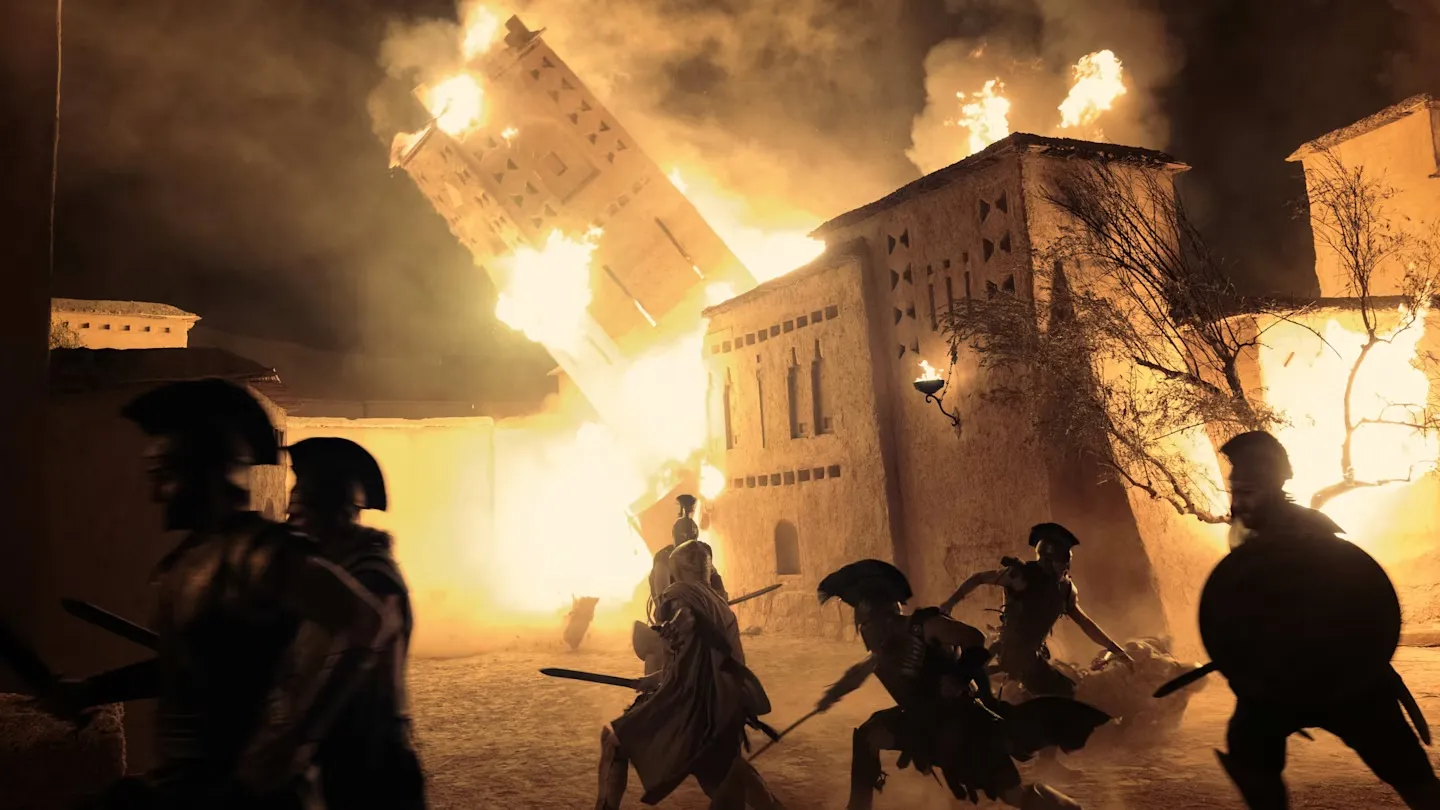
4. But why all this suffering? Not simply to punish the hero’s pride in breaking with his commander and choosing his own course (“I’ve followed Agamemnon long enough”) nor merely because, having blinded the sea god’s one-eyed son, he sets the sea against him. Odysseus bears a far heavier guilt, the very thing that makes a hero hero and an epic epic: war. And war, of course, is unjust. There is no divine mandate, and the woman is merely a pretext; what the Greek coalition truly covets are the trade routes controlled by Troy. Not a fight for honor, but an invasion driven by power and profit. Ten years of war leave countless dead on both sides, and the Greeks, as its instigators, cannot escape responsibility. The blood debt incurred on the expedition becomes the burden of the homecoming. Still more unforgivable than the war itself is Odysseus’s most celebrated means of winning it: the Horse, a sinister deception disguised as a sacred offering of peace, exploiting the Trojans’ reverence for a shared faith and inducing them to carry the seed of their own destruction through walls that force could never breach. The host opens his gates to the guest; the guest responds by pillaging his house. So what grounds have these guests for complaint when they set sail for home, laden with spoils and proud of their cunning, finding only hostility everywhere they land, expelled, hunted, abducted by every host? Worse still, it is now their own homes that are overrun by uninvited guests: Agamemnon is murdered in his own bed by his wife, while Odysseus’s palace teems with parasitic suitors, pressuring Penelope to betray her husband as well. The Greeks have won the war, but at the cost of trampling the divinely guaranteed trust between host and guest—the so-called “Zeus’s Law,” whose violators will ultimately reap what they have sown, dragging the entire Mycenaean civilization with them toward catastrophe as the Late Bronze Age collapse looms on the horizon.
5. The sacred bond between host and guest, broadened into “all that’s ever sacred between people,” and the way war destroys it—this is what Nolan extracts from The Odyssey. Yet the parallax between this modern antiwar perspective and the ancient Greek texts soon comes into view. Zeus is indeed Zeus Xenios, protector of guests and strangers, but such protection is by no means exclusive: the gods sanction not only friendly relations, but also war, violence, even cunning and deception— among Athena’s many titles, for instance, are Areia (warlike) and Mēchanitis (contriver), and the Trojan Horse is associated with her counsel in the epic tradition. Olympus, after all, is no unified authority but a court riven by factions and rivalries, where the gods have their own desires, grudges, and favorites, each taking sides in mortal wars according to their own allegiances. In the Iliad, Zeus himself, the guardian of oaths, orders Athena to lure the Trojans into breaking a sworn truce, so that peace does not come too easily. Contradictory? That is precisely the Homeric worldview: there is no single absolute measure of morality. Oaths and hospitality are only two among many sacralized values, alongside revenge, honor, kinship, and fate, which may well contradict and counterbalance one another. By removing the anthropomorphic gods, therefore, Nolan also removes the heterogeneous and irreducible normative forces they embody, replacing them with a single, supreme Law. Though it still bears the name of Zeus, it has little in common with xenia as a concrete system of reciprocal obligation among aristocrats, and comes much closer to the Golden Rule as a universal ethical principle, given one of its best-known formulations in the New Testament: “In everything do to others as you would have them do to you” (Matthew 7:12). The polytheistic court of the gods becomes a monotheistic court of law, where conquest and cunning, once celebrated as glorious achievements, can now be condemned as intolerable evils. As in Nietzsche’s genealogy of morality, plural gods give way to a single law, and external law to an internalized conscience. Nolan Romanizes Greece, then Christianizes Rome.
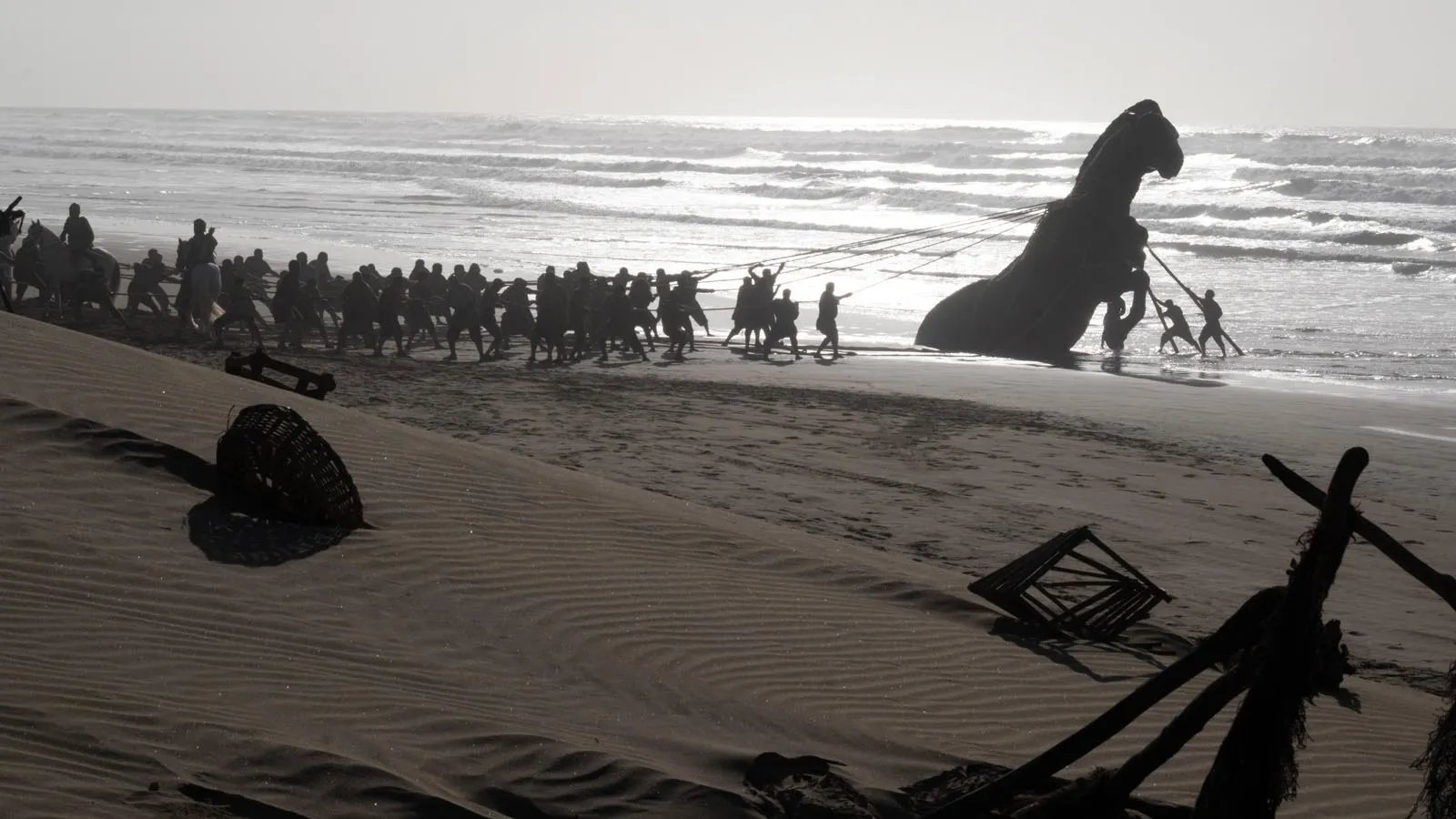
6. Yet Nolan has not invented the antiwar theme out of whole cloth. Homer’sTheOdyssey is already a work of “postwar literature”: its heroes have learned the cost of war, and the pursuit of kleos (heroic fame), so central to the Iliad, is reversed as Odysseus’s homecoming becomes a return to the value of finite life. Achilles himself reappears among the shades of the underworld, overturning his famous earlier choice to exchange life for glory: “By god, I’d rather slave on earth for another man... than rule down here over all the breathless dead.” But Homer merely lowers war’s place in the hierarchy of values; he does not strip it of legitimacy. Nolan, by contrast, makes war a violation of the Law. To speak of a “violation,” however, is already to assume that something intact once existed to be violated: an Aegean world in which kings stayed peacefully at home and xenia held a common order together, until the coalition raised its armies and the Horse entered Troy, after which everyone began to fear everyone else. War is pushed outside the normal order of society,reduced to the exceptional ambition of certain rulers and the devastating broken-windows effect that follows. But a palace society without armed plunder, where people simply welcomed one another as guests? Nolan punctures one myth of war only to erect an even more fictitious myth of peace in its place. The point, of course, is not to play the pedantic historian or classicist, cataloguing every inaccuracy or infidelity in Nolan’s adaptation. Epic has never ceased mutating since the moment of its formation, and cinema has every right to reinterpret it from the standpoint of the present. The problem is that Nolan’s depiction of the Trojan War as a breakdown of the supposedly harmonious old order, one that sends Greek civilization into a dark age, fits all too neatly with a dangerous conservative fantasy now flourishing across the world. Whether it is on the right—MAGA in America, Ming restorationism in China—or the left—a lost socialist past, the idealized multilateral international order—the story is much the same: construct a prosperous, pure, orderly past, then blame the disorder of the present on a few historical sinners or one decisive moment of moral degeneration. An antiwar premise thus arrives at a restorationist conclusion, the longing for home mingling with nostalgia for the old order.
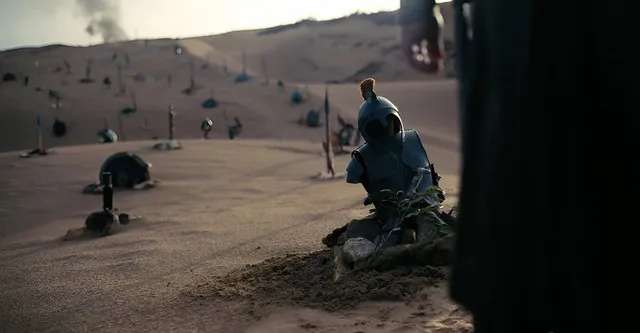
7. Things have come to such a pass that our protagonist Odysseus, traditionally the great deceiver famed for disguise, lies, and political cunning, has been almost completely inverted into an unusually principled warrior, who refuses an ambush even on the hunt, insisting on plucking his bowstring first to alert the prey for a fair duel. As for war, he has reservations from the outset and joins only because military obligation leaves him no other way to protect his people. How, then, can such a man also become the inventor of the Trojan Horse? Because the age and the collective sweep him along, makingeven the most righteous sin. But the idea of Odysseus as a sinner is hardly Nolan’s invention: the Romans, self-styled descendants of Troy, had already condemned the wickedness of the Horse in the Aeneid; later, when Virgil leads Dante through Hell, Odysseus is placed among the fraudulent counselors, burning eternally in flames. Yet even in these hostile traditions, this sinful Odysseus remains at least an unrepentant villain, carrying out his wicked exploits by force of his own will. What Nolan requires, on the other hand, is a fallen man who realizes that he has violated the Law and sinks into endless repentance over the catastrophe he has helped create. Guilt and remorse consume Odysseus’s entire inner life, leaving him gloomy, taciturn, almost inert, and all but stripped of mētis (cunning intelligence), the very quality that oncedistinguished him from heroes who prevail mainly by strength, making him the favorite of Athena, herself a master of strategy. Here, however, the goddess’s image becomes instead the condensation of Odysseus’s guilty conscience, a phantom superego that keeps issuing moral commands. By the same logic, the retrospective narration of his ten years of wandering is no longer a virtuoso act of self-mythologization before a hall full of guests. Instead, across desolate landscapes, we see an almost speechless refugee who, under the influence of the lotus fruit transposed from another episode, forgets his own story for a time, allowing Nolan to recode the epic’s nonlinear structure as the return of traumatic memory. Myth gives way to psychodrama; the bard’s song becomes a PTSD flashback. Odysseus, a Vietnam veteran returned from Troy, is haunted by his own crimes.
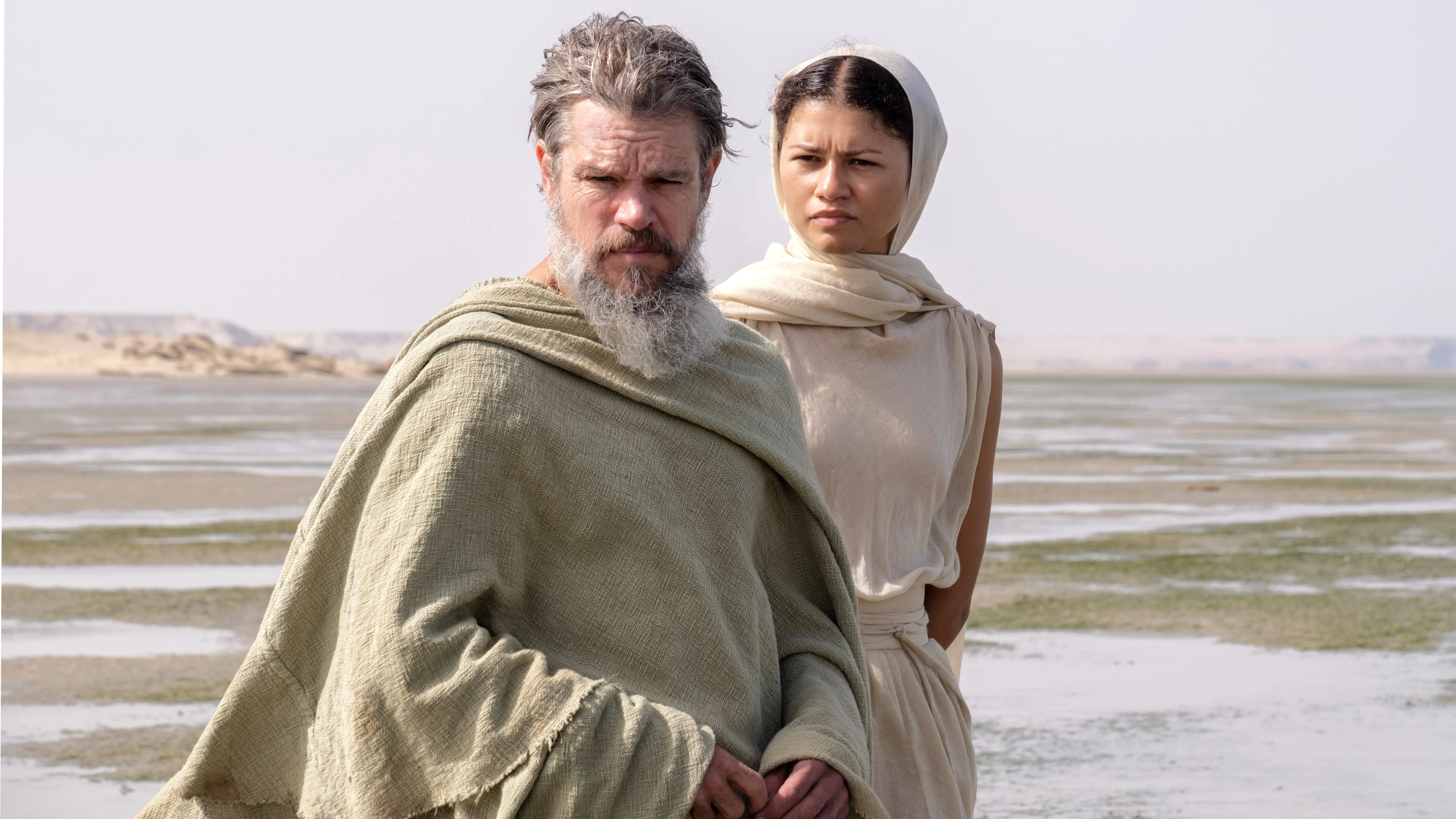
8. Yet it is precisely this overwhelming guilt and self-judgment that allow Nolan to grant Odysseus the unique qualification to bear the consequences of the war. Fate, the last surviving transcendent inheritance of myth, chooses himafter all. As the shades have foretold, he survives to the end, through the destruction of his fleet and the loss of his home, witnessing the Law broken and the old order collapse while struggling to atone for it all. We are back with the inventor in Oppenheimer (2023), his conscience turning him against his own creation: the Trojan Horse is the atomic bomb, andOdysseus, like the twentieth-century nuclear physicist, becomes the man who opened Pandora’s box and unleashed a chain reaction he could no longer control, remaking the world in the process: from the heroic age into four centuries of darkness, or from the prewar European scientific community into the Cold War order of nuclear deterrence. But the man who witnesses such a historical rupture must never plead ignorance, or else he’d become a technocrat, merely a cog in thesystem that sustains the banality of evil. On the contrary, he must claim responsibility, too much of it: “I am become Death, the destroyer of worlds”; “One man’s idea. One man’s trick. To break Zeus’ law forever.” In that recurring look on Cillian Murphy’s or Matt Damon’s face, the look of a man who has “realized what he has done,” everything becomes the inner drama of a great man, with man meant quite literally as male, as though committing the crime were precisely what made him the only one capable of fully understanding its horror, and his private, unshareable suffering a means of bearing and repaying the debt on everyone else’s behalf. The Odyssey, or: The Passion of Odysseus? By monopolizing atonement, the former perpetrator becomes the center of morality once again, even its appointed judge and executioner, restoring the violated Law through yet another slaughter. Telemachus, the future king, is spared contamination by the cycle of violence; Odysseus carries all the old debts away with him into exile toward the edge of the world, much as Batman chooses to bear the blame himself in order to preserve the community’s sustaining myth. The historical sinner who brings the age of heroes to an end thus becomes its last hero. No wonder The Odyssey begins by dismantling the hero in myth, only to reinstate him in history. The question put to Nolan in a recent widely discussed interview finds its clearest answer here: greatness does not need to apologize; rather, it is the apology that makes greatness possible again—a self-coronation performed in the name of self-critique, only with thorns for a crown.